nickmofo@mastodon.social

This month an MIT committee released a detailed report on AI and education:

aiandeducation.mit.edu/report/

“The committee did supply early drafts of the report to ChatGPT to identify redundant / overlapping sections. Some of the graphs and statistical summaries in Appendix C were generated with Codex ... Members of the committee also used AI to synthesize and present data and reports (e.g., summaries of other schools’ published positions on AI) to inform committee discussions.”
|
Embed
Progress spinner
nickmofo@mastodon.social

The report is not policy, but provides rather official recommendations in response to a charge from the chancellor, provost, and faculty chair in January.

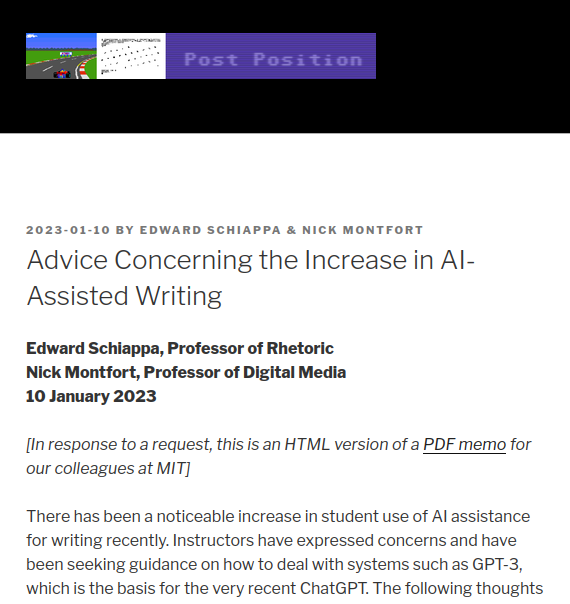
I was interested to see that it elaborates several of the points made by two MIT professors who wrote a completely unsolicited report in January 2023 — one of those was me:

nickm.com/post/index.html%3Fp=

Beginning of a Post Position blog post “Advice Concerning the Increase in AI-Assisted Writing” by Prof. Edward Schiappa and Prof. Nick Montfort. See the link in the post for the screen reader friendly text of the entire report

|
Embed
Progress spinner
natematias@social.coop

@nickmofo looking at this list of suggestions, it strikes me as a reasonable list, and also a huge amount of work. Re-tooling an entire university's educational experience is a lot of work, and to do it well would require a *lot* of additional labor from faculty.

At the scale of MIT, I estimate it would cost about 50 million dollars at minimum?

|
Embed
Progress spinner
nickmofo@mastodon.social

@natematias Although not a focus of the original report Ed and I did, it's useful to consider earlier major changes in text technologies, including word processing, the Web, and Wikipedia. As computing became essential to education higher ed did have to “retool” to provide access & use computing effectively. It was costly — but was accomplished

|
Embed
Progress spinner
natematias@social.coop

@nickmofo oh absolutely. My back-of-the-envelope calculation was an exercise in practical thinking/planning. For an institution like MIT, I imagine $50m can be found/raised, partly through identifying services that are no longer useful and directing those funds toward people who can imagine what comes next.

|
Embed
Progress spinner
nickmofo@mastodon.social

@natematias Text technologies do emerge more or less rapidly...

For reference, a very successful $50 million educational project done by MIT

en.wikipedia.org/wiki/Project_

|
Embed
Progress spinner
nickmofo@mastodon.social

@natematias ($50 million in 1983–1991 dollars!)

|
Embed
Progress spinner
mbattles
mbattles

@natematias I wonder how such an effort could support MIT’s “other academic staff,” who outnumber faculty roughly 4 to 1, and who mostly lack release time, offices, or sabbaticals, resources crucial to revising and innovating pedagogically.

|
Embed
Progress spinner
In reply to
mbattles
mbattles

@mbattles (To be fair, last year I participated in a backward-design workshop run by MIT’s amazing ed-design team, all of whom are experienced pedagogues across disciplines. Most attendees were adjuncts. Such efforts could use a big boost!)

|
Embed
Progress spinner